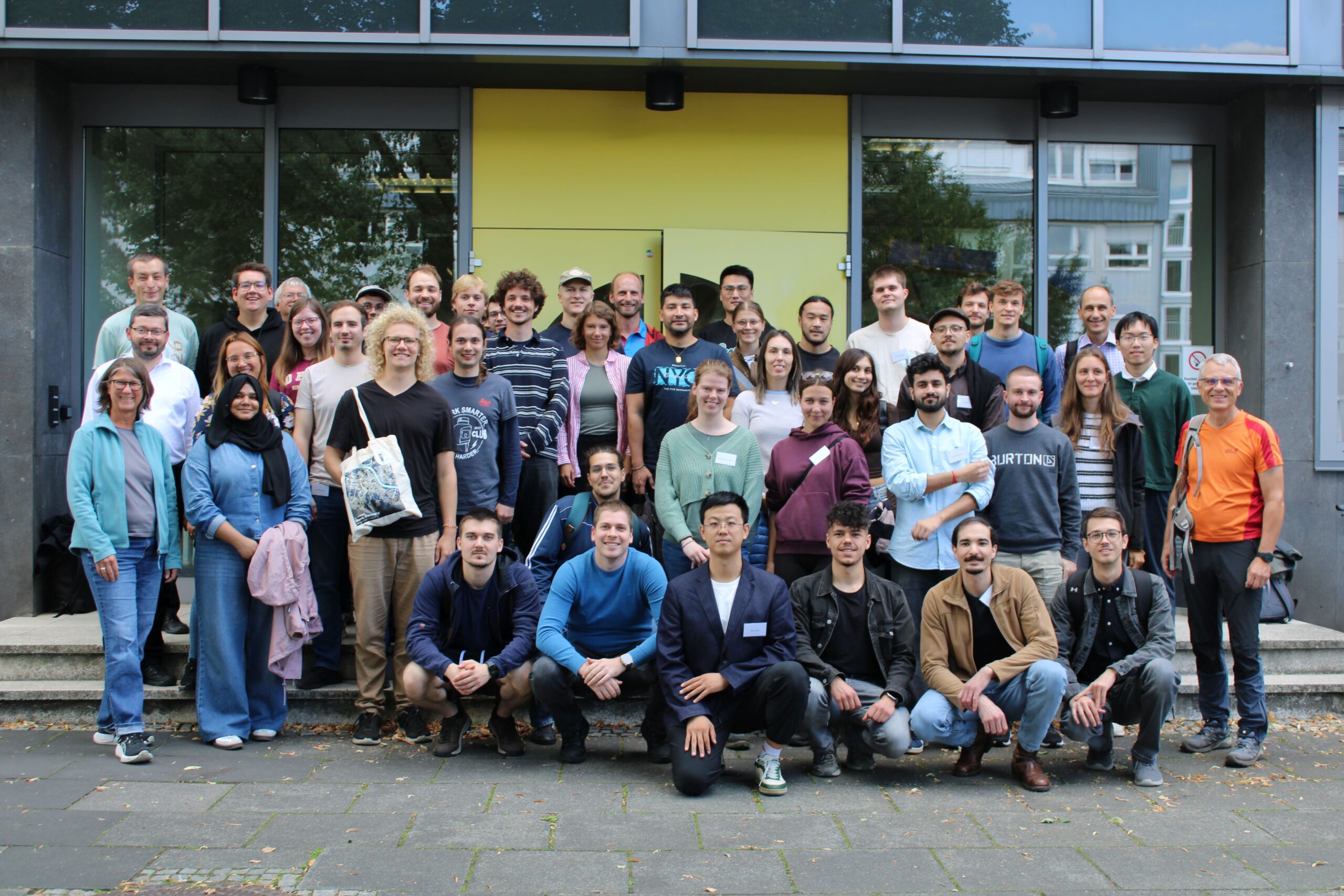
Students of the Department of Geodesy and Geoinformatics at the TLS-Defo International Summer School in Bonn
Students of the Department of Geodesy and Geoinformatics Attend the International Summer School TLS-Defo in Bonn
Second-cycle students of Geodesy and Geoinformatics at the University of Sarajevo – Faculty of Civil Engineering, Nadir Katana and Emel Šarvala, participated in the international summer school “TLS-Defo: Advanced Monitoring of Infrastructure”, held from 7 to 11 September 2026 at the University of Bonn, Germany. The summer school was organised within the DFG Research Unit FOR 5455, “Deformation Analysis Based on Terrestrial Laser Scanner Measurements (TLS-Defo)”, and brought together master’s and doctoral students, as well as researchers from several countries and related engineering disciplines.
The programme focused on state-of-the-art methods for infrastructure monitoring using terrestrial laser scanning. Through lectures and practical workshops, participants worked on point cloud acquisition and quality control, comparisons between professional TLS systems and low-cost LiDAR sensors, neural methods for geometry representation, and deformation analysis based on point cloud comparisons. A special part of the programme included a technical excursion to Campus Klein-Altendorf, where systems and test areas for the calibration and testing of laser scanners were presented.
During the poster sessions, participants presented their own research and exchanged experiences with fellow students and professors. Nadir Katana presented his research on the development and analysis of low-distortion map projections for railway infrastructure, while Emel Šarvala presented his research on the application of the BeiDou satellite constellation in GNSS RTK measurements in urban canyons. The poster sessions provided an opportunity for direct professional discussions and valuable feedback from participants with diverse research backgrounds.
Participation in the summer school enabled the Faculty of Civil Engineering students to expand their knowledge in terrestrial laser scanning, deformation analysis and geodetic monitoring, while also establishing new contacts with students and researchers from the international academic community. The knowledge and materials acquired during the summer school may serve as a basis for introducing new methods and examples of good practice into teaching and research activities at the Department of Geodesy and Geoinformatics.
The students would like to express their gratitude to the management and members of the Council of the University of Sarajevo – Faculty of Civil Engineering for their support and co-financing of their participation in this international summer school. They also intend to share the knowledge they have acquired with their fellow students through a workshop, providing current students with an insight into the benefits and positive aspects of extracurricular academic activities.

You may also like

HR Excellence in Research
Professional Visit of Students to the “Europe Square” Construction Site