
Study Programmes
Development and Reform of Study Programmes
The new higher education system, based on the principles of the Bologna Process, was introduced at the Faculty of Civil Engineering of the University of Sarajevo in the winter semester of the 2006/2007 academic year, following several years of preparation, extensive discussions among academic staff and consideration of various proposals.
A significant contribution to the development of the new curricula was made through international cooperation with faculties of civil engineering at European universities that had already begun implementing, or were actively preparing to introduce, the new European higher education system in accordance with the Bologna Process. These included the universities of Stuttgart, Vienna, Lausanne, Zurich, Bochum, Zagreb and Munich.
Particular attention was paid to the needs of the civil engineering sector when developing the new curricula. These needs were assessed through numerous contacts and exchanges of experience between experts from the Faculty of Civil Engineering in Sarajevo and their colleagues working in design and construction practice. Compared with the traditional system of study, the new curricula were better aligned with the requirements of the civil engineering sector and contemporary developments in the construction industry.
Structure of Studies
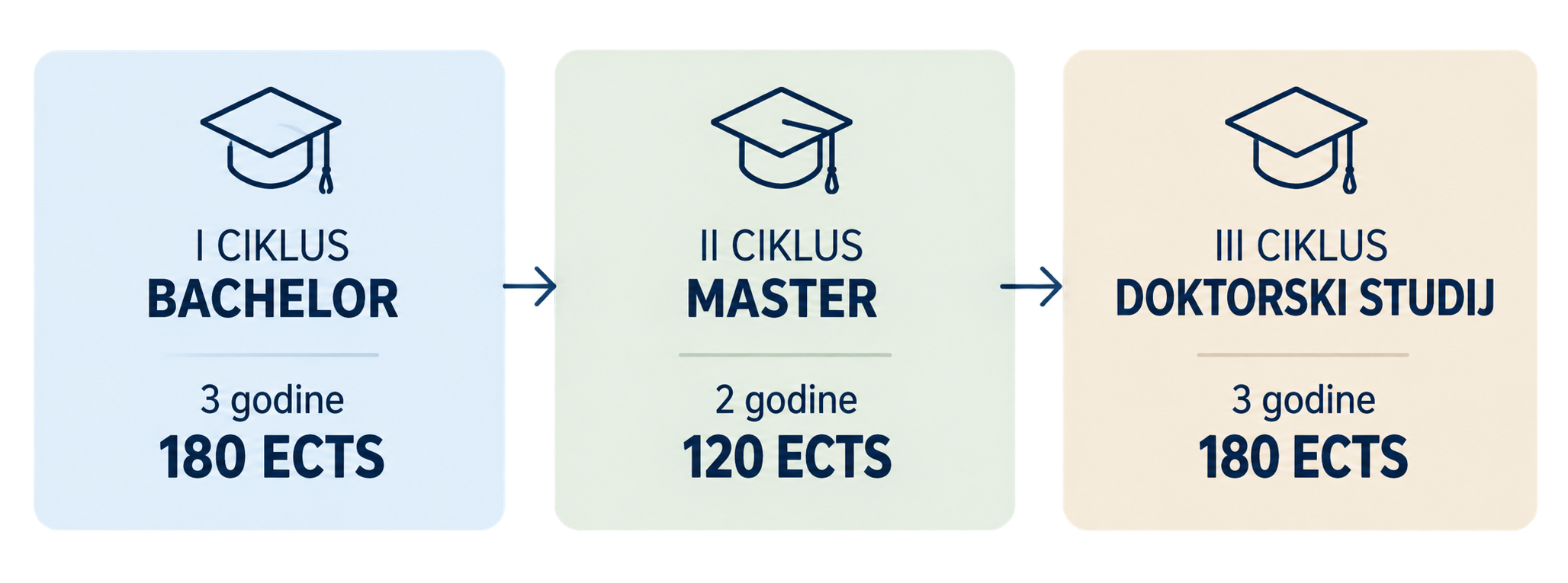
The higher education reform introduced a new study structure consisting of three cycles: the First Cycle – Bachelor's Degree, the Second Cycle – Master's Degree, and the Third Cycle – Doctoral Studies.
The First Cycle – Bachelor's Degree lasts three years. Upon successful completion, students are awarded the appropriate academic degree in the field of Civil Engineering or Geodesy, depending on the study programme.
Successful completion of the First Cycle is a prerequisite for enrolment in the Second Cycle – Master's Degree, which lasts two years. Upon successful completion, students are awarded a Master's degree in the field of Civil Engineering or Geodesy. This qualification differs from the former academic degree of Master of Science, which was awarded under the previous higher education system.
Students are encouraged, in accordance with their abilities and professional goals, to complete both cycles of study, thereby acquiring broader professional knowledge and competencies required for careers in civil engineering and geodesy.
Significant changes were also introduced in the process of obtaining a doctoral degree. The Third Cycle – Doctoral Studies lasts three years, comprising six semesters. Unlike the previous system, doctoral studies include structured coursework and examinations during the initial phase, followed by research activities and the preparation of a doctoral dissertation. Upon successful completion, students are awarded the academic degree of Doctor of Technical Sciences in the relevant field of Civil Engineering or Geodesy, in accordance with applicable regulations and the relevant study programme.
ECTS – European Credit Transfer and Accumulation System
Introduction of the ECTS System
Alongside the reform of the study structure and the transition to a model comprising a three-year Bachelor's degree and a two-year Master's degree, a new system for measuring student workload and academic achievement was introduced – ECTS (European Credit Transfer and Accumulation System).
Study Structure and ECTS Credits
Under this system, each academic year is worth 60 ECTS credits. The number of credits awarded upon successful completion of each study cycle is presented below.
First Cycle – Bachelor's Degree
The First Cycle lasts three years. Upon successful completion, students earn a total of 180 ECTS credits.
Second Cycle – Master's Degree
The Second Cycle lasts two years and carries an additional 120 ECTS credits. Upon completion of both the First and Second Cycles, which together last five years, students earn a total of 300 ECTS credits.
Third Cycle – Doctoral Studies
The three-year doctoral programme comprises a total of 180 ECTS credits, equivalent to 30 ECTS credits per semester.
The Importance of the Bologna Process
By introducing the Bologna Process, the Faculty of Civil Engineering of the University of Sarajevo took an important step towards modernising higher education, improving the quality of study programmes, strengthening international cooperation and aligning education with European standards and the requirements of contemporary engineering practice.